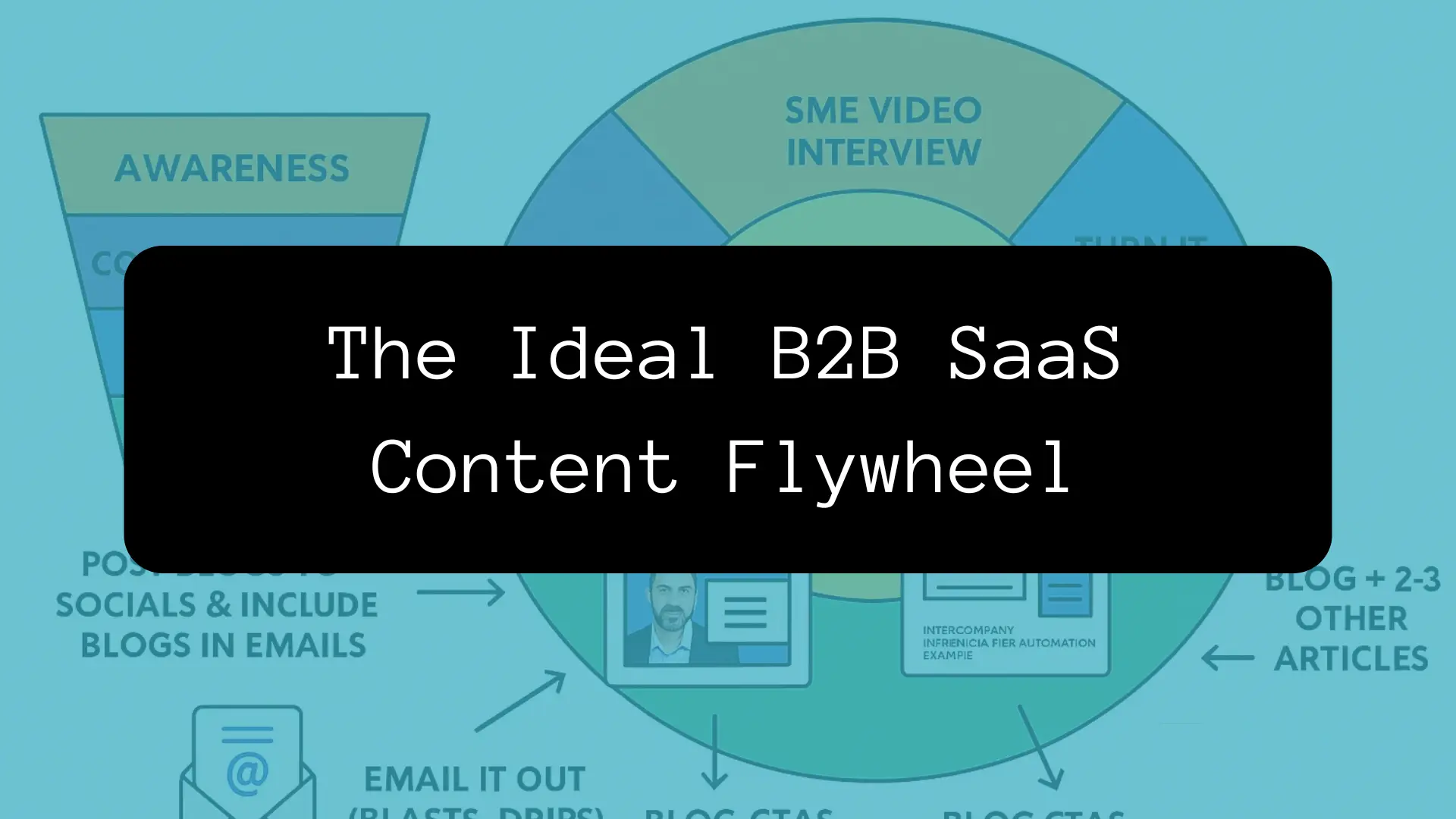
What Is a Content Flywheel?
A content flywheel is like a continuous funnel that doesn’t stop at a conversion. Instead, it builds continuous momentum with a strategic content mix, ICP-specific assets (AKA personalized content), and customer advocation.
In quicker terms, it’s a content mix that’s focused on a single ICP and distributed across select channels. Start with your target and a broad asset, then splice that asset into channel-specific formats.
For Example: A Multi-Company Accounting Platform (Fintech)
Let’s say you run the content marketing and SEO for a fintech SaaS that handles intercompany accounting (me currently).
To kick off your flywheel, you might:
- Start with a SME video interview
- Post to YouTube
- Splice for social content
- LinkedIn, niche B2B communities, etc.
- Have SME “champions” post & promote on LinkedIn
- Turn it into a gated “playbook”
- Include SME photo, name and bio in playbook
- Include directs CTAs
- Promote that playbook in ads
- Target “intercompany reconciliation automation example” in a
blog + 2-3 other articles- Include mid-line CTAs in blogs leading to that playbook
- Use UTMs for blog CTAs so you know they’re working!
- Email it out (blasts, drips)
- Post blogs to socials & include blogs in emails
- Use case studies/customer success stories in social and on relevant
front-facing pages - Monitor engagement & key events
You see how they all drive and feed into each other, but not as linearly as a traditional funnel?

This kind of flywheel generates leads while also compounding trust. Each asset feeds the next, creating a loop where prospects discover you through search, engage through gated content, and convert through relevance and resonance.
Understanding the Goal of Your Flywheel
Of course, the core goal is sales. But in B2B, conversions aren’t limited to sales, because content marketing starts with education and trust-building. So you redefine what conversions are. For example:
- Qualified contact form submissions
- One-pager/product guide downloads
- Webinar/virtual event sign-ups
Not direct purchases, but still considered conversions.
Point being: You’re not retail or e-commerce, selling in high volumes each day on Amazon or Google Shop. Prices are high and sales cycles are long in B2B SaaS. You likely sell a high-ticket product or service that requires a kickoff call and navigating miles of red tape.
So as a B2B content marketer, your job is to get people to your sales team.
And once a deal closes, you can reference visitor journeys and CRM data to see how people are travelling across your flywheel.
How to Get Your Content Flywheel Rolling
My favorite way is to start with a video interview with an internal subject matter expert (SME). If you work at an agency, it’d be a quick Teams call with one of your client’s SMEs.
This route is great because it’s so easy to splice video content into other media types.
Starting with a social media calendar, a blog series, or one-pager doesn’t make as much sense since these are mostly downstream assets. They rely on source material to be effective and just aren’t as “dense” as an interview packed with authoritative insights.
Hopefully you’ll also be using that video in your broader pillar article (video boosts on-page SEO) and posting it to YouTube. Then you can retarget any YT viewers with ads that include your “playbook” or one-pager.
But I haven’t mentioned the most powerful starting point for many B2B SaaS:
Webinars, live demos and virtual events.
These are often the strongest sales enablers for B2B SaaS. Get them on a webinar, in a live demo, or any other virtual event where your engagement/sales teams can make contact.
If this is true for your organization, aligning your content flywheels with an event calendar or ramping up webinar/demo frequencies if you only do it a couple times a quarter may be worth considering.
Then you base SME interviews on webinar topics. For demos, a targeted (but intensive) strategy is building playbooks for each ICP type that benefits from or is impacted by your product/service.
The more targeted the better, but it also takes more audience/VoC research and grit.
Will You Use This Strategy?
It doesn’t matter whether you’re agency side or in-house. It’s tough to shift strategy.
But this way, each of the assets you create have a higher chance of being seen, since they all follow a clear narrative and have multiple touchpoints. Flywheels aren’t completely rebuilding the traditional funnel exactly…just expanding it.
At my current company, after shifting to a longtail TOFU blogging strategy that feeds into a larger flywheel, we signed a historic number of clients for D365 licensing review services. Looking at visitor journeys, blogs attached to that flywheel consistently appeared in the path to conversion. Webinar sign-ups and one-pager downloads flew through the roof, as well as webinar sign-ups from SME social media posts.
Just something to consider.
Let’s Connect
If you’re unsure how to get started, be it audience research, keyword targeting, or complete content strategy building, reach out. I’d love to help.